One drives. One sees the way. Keep talking.
Blind Driver is a co-op getaway game I built around a simple problem: you've just robbed a bank, the police are coming, and your driver has broken their glasses. One player accelerates, brakes, and steers through a heavily blurred windshield. The navigator sees clearly, reads the map, and talks them through an endless forest of procedural roads.
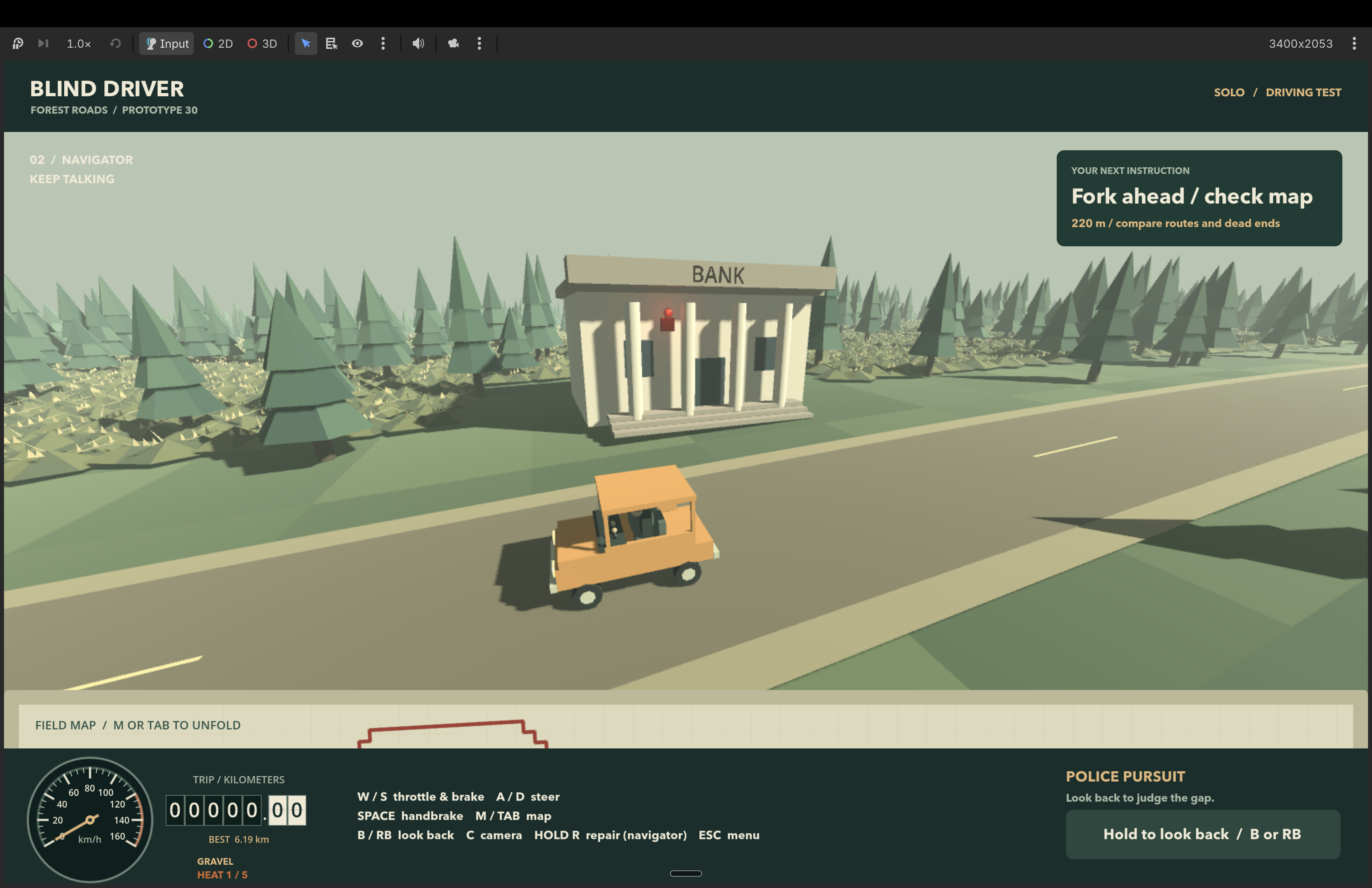
Every route is a conversation: take a hazardous shortcut or a longer, quieter road, dodge rocks and spike strips, time moving bridges, and decide whether there's time to stop for repairs. Opening the map blocks the navigator's view of the road, so even checking the next turn has a cost. You can play couch co-op on a shared screen, join a friend online with a room code, or learn the handling in solo practice.
The game also doubles as an experiment in AI communication. A Python evaluation harness puts a visual agent in each seat, with separate screenshots and ordinary game controls. The driver still sees the blur, and the navigator can give directions but cannot steer. Cohere and Google harnesses record their messages, response times, progress, and collisions while the shared simulation keeps running. I'm interested in how agents learn to communicate under time pressure; the current harness evaluates models and records runs, with reinforcement learning as a future direction.
Under the hood, Godot and GDScript handle the car, procedural world, hazards, damage, and police pursuit. A Node.js WebSocket relay connects online players while the driver's client owns the simulation, and a Godot Web export brings the game to desktop browsers. The optional Python harness produces logs, metrics, dashboards, and recap videos for the AI experiments.
Play Blind Driver in your browser, watch the video on YouTube, or explore the source code and AI harness on GitHub.
Back